


Overview
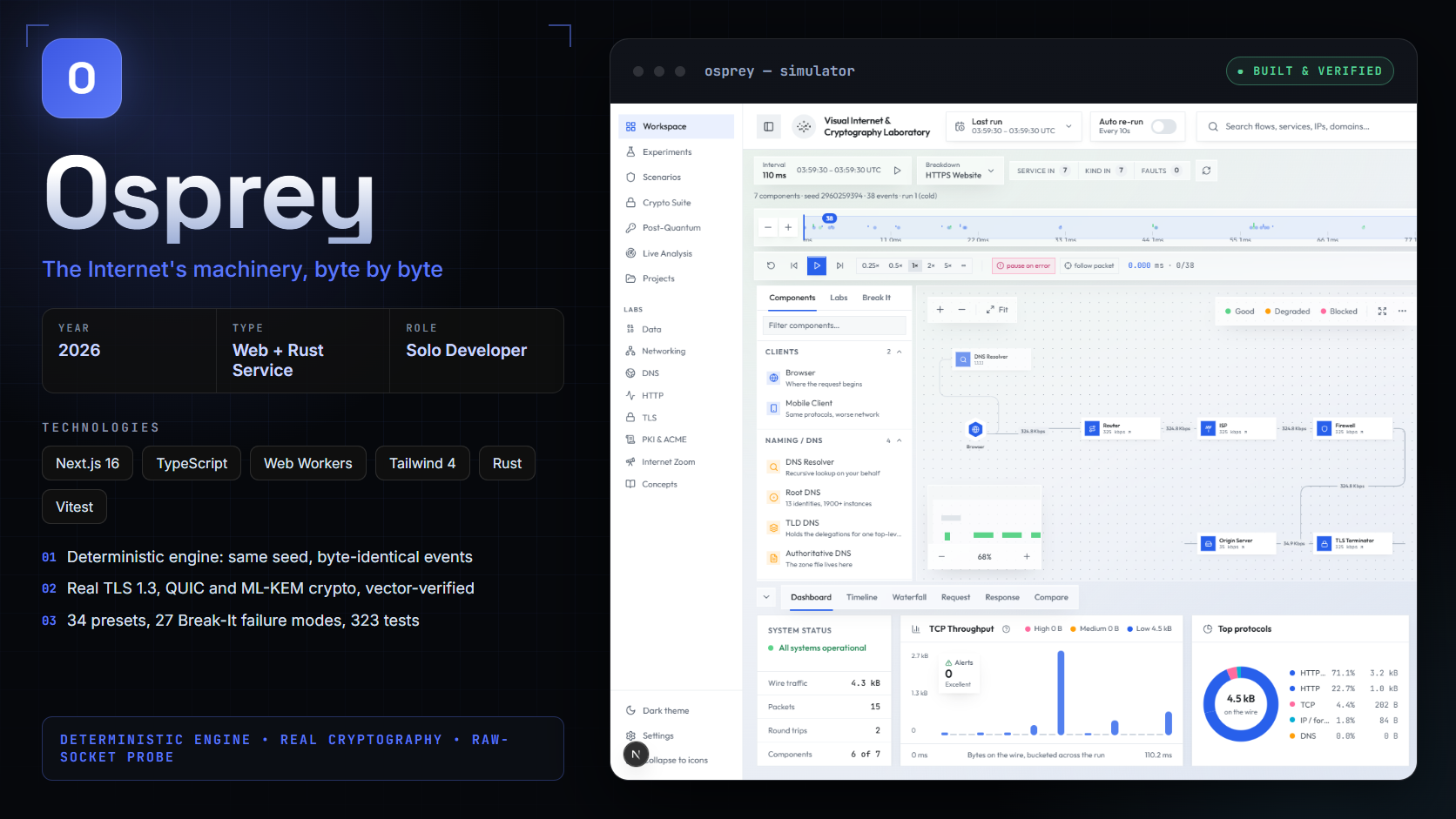
Osprey is built around one idea: build, connect, send, watch, inspect, break, understand. You lay out an architecture on an infinite canvas (clients, resolvers, CDNs, load balancers, firewalls, Kubernetes services, databases), send a request through it, and step through everything that happens on the way. A deterministic protocol engine running in a Web Worker emits a single event stream, and the canvas, timeline and inspector all render that same stream, so they can never disagree.
Nothing cryptographic is mocked. Hashes, AES, DES, RSA, the TLS 1.3 key schedule, QUIC Initial keys and post-quantum ML-KEM all run for real in the browser and are checked against published test vectors. Alongside the simulator, a live-analysis mode measures real hosts, and an optional zero-dependency Rust probe captures the bytes a browser or Node TLS client never shows.
Technologies
- - Next.js 16 / React 19
- - TypeScript
- - Tailwind CSS 4
- - Web Workers
- - Zustand / IndexedDB
- - Rust (raw-socket probe)
- - Vitest / Playwright / axe
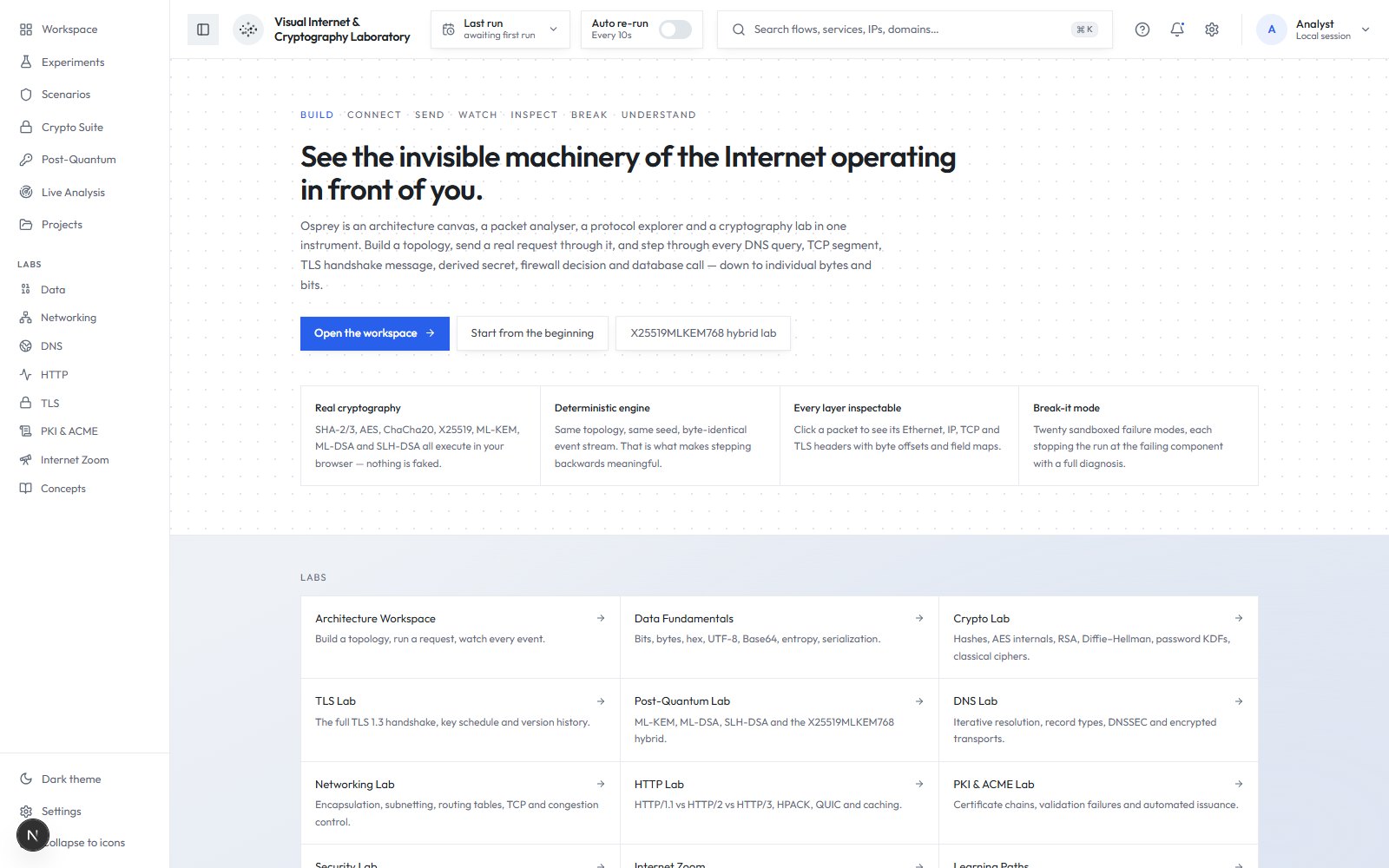
Home: the labs and the architecture workspace
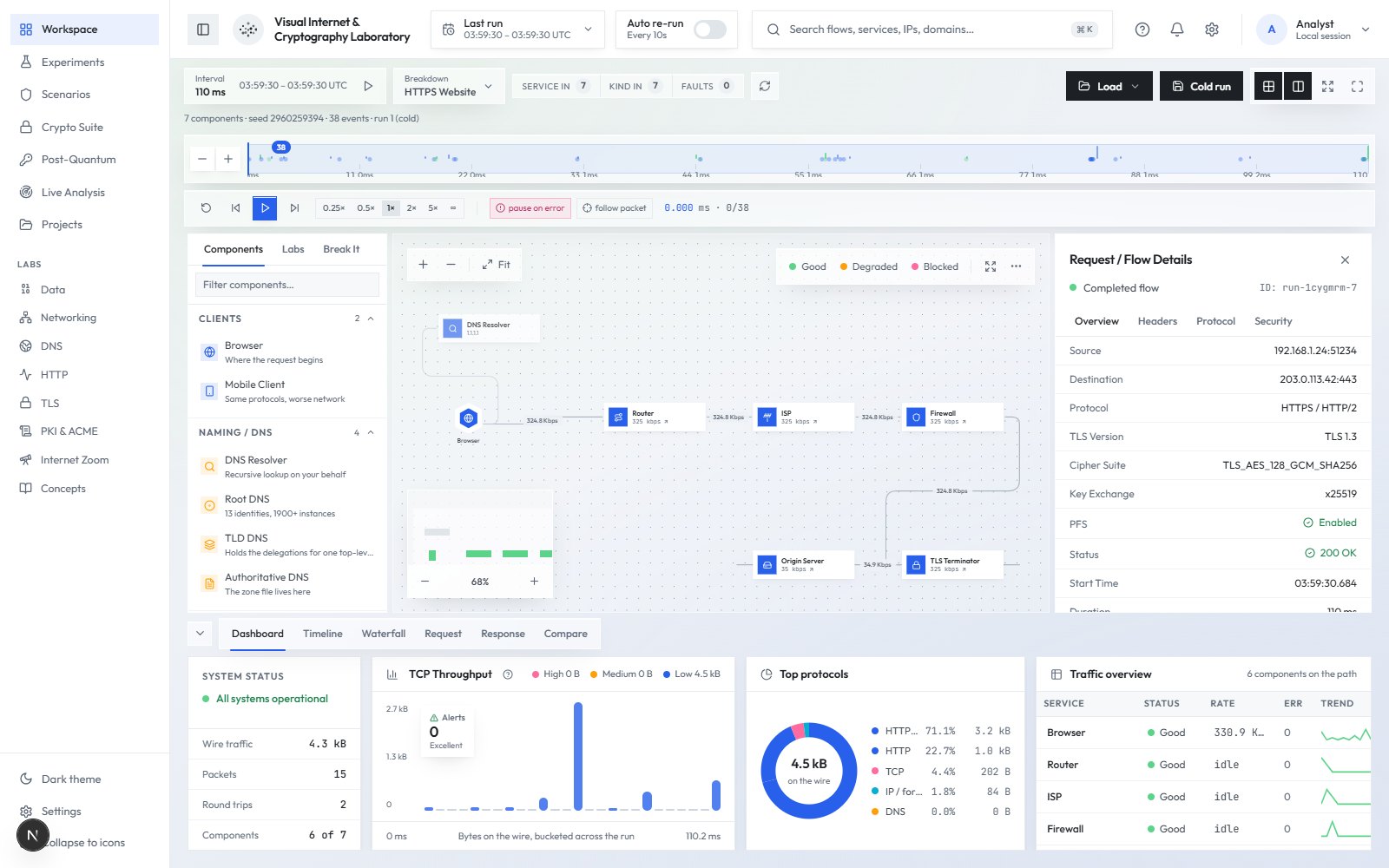
Architecture lab: a request flowing through a built topology
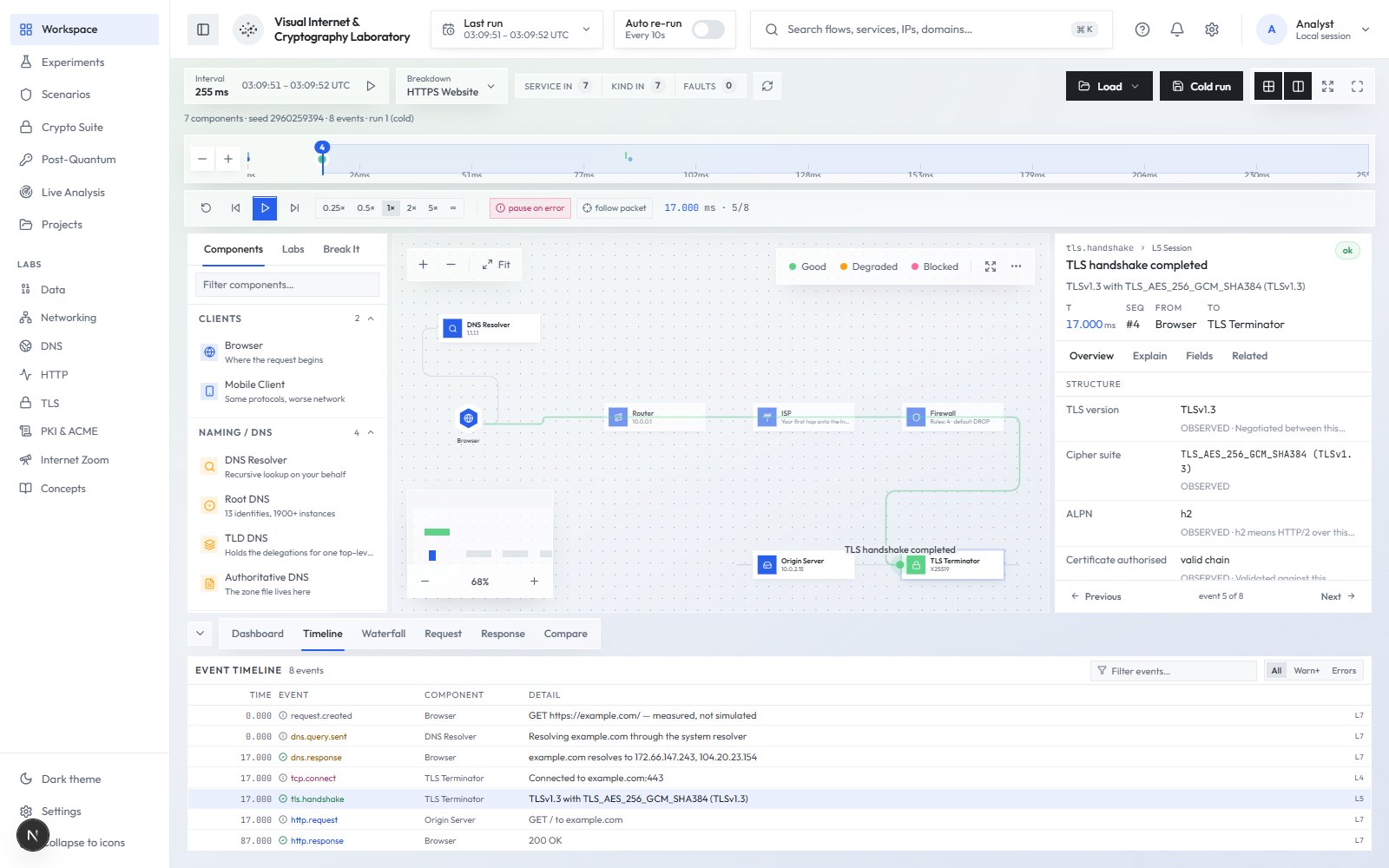
Event timeline and inspector for a run, down to each TLS message
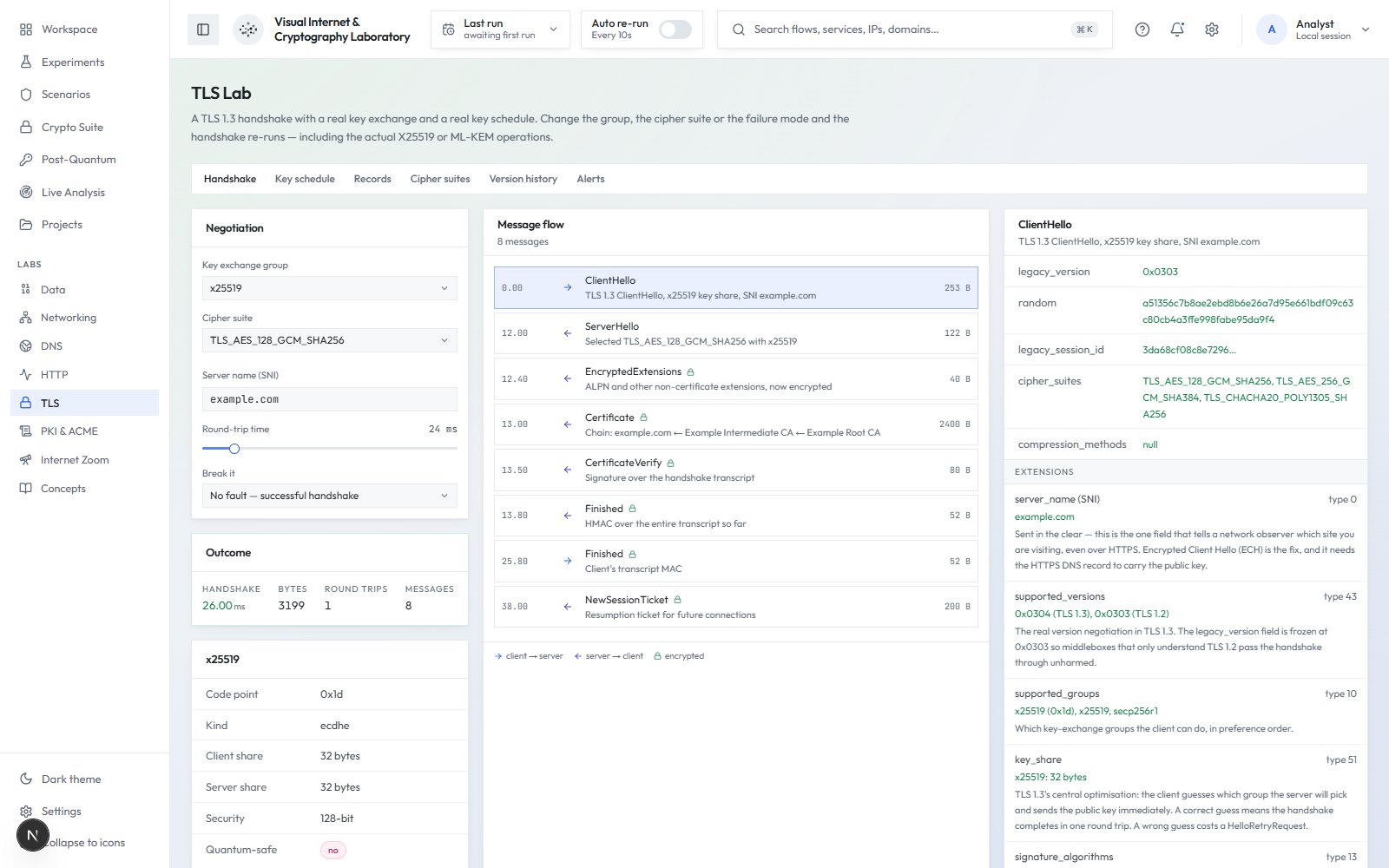
TLS lab: a real TLS 1.3 handshake, message by message
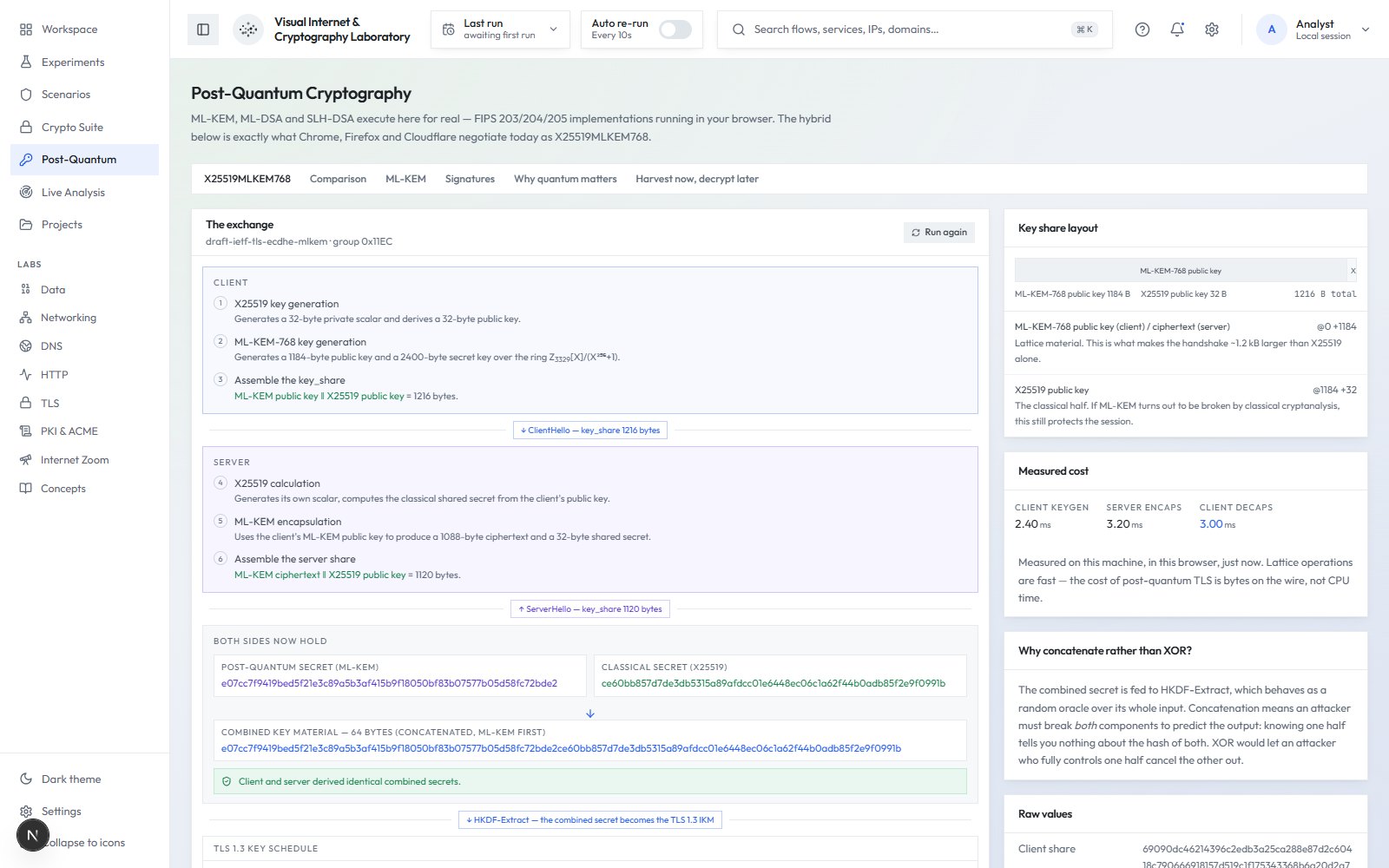
Post-quantum lab: the X25519MLKEM768 exchange, computed in the browser
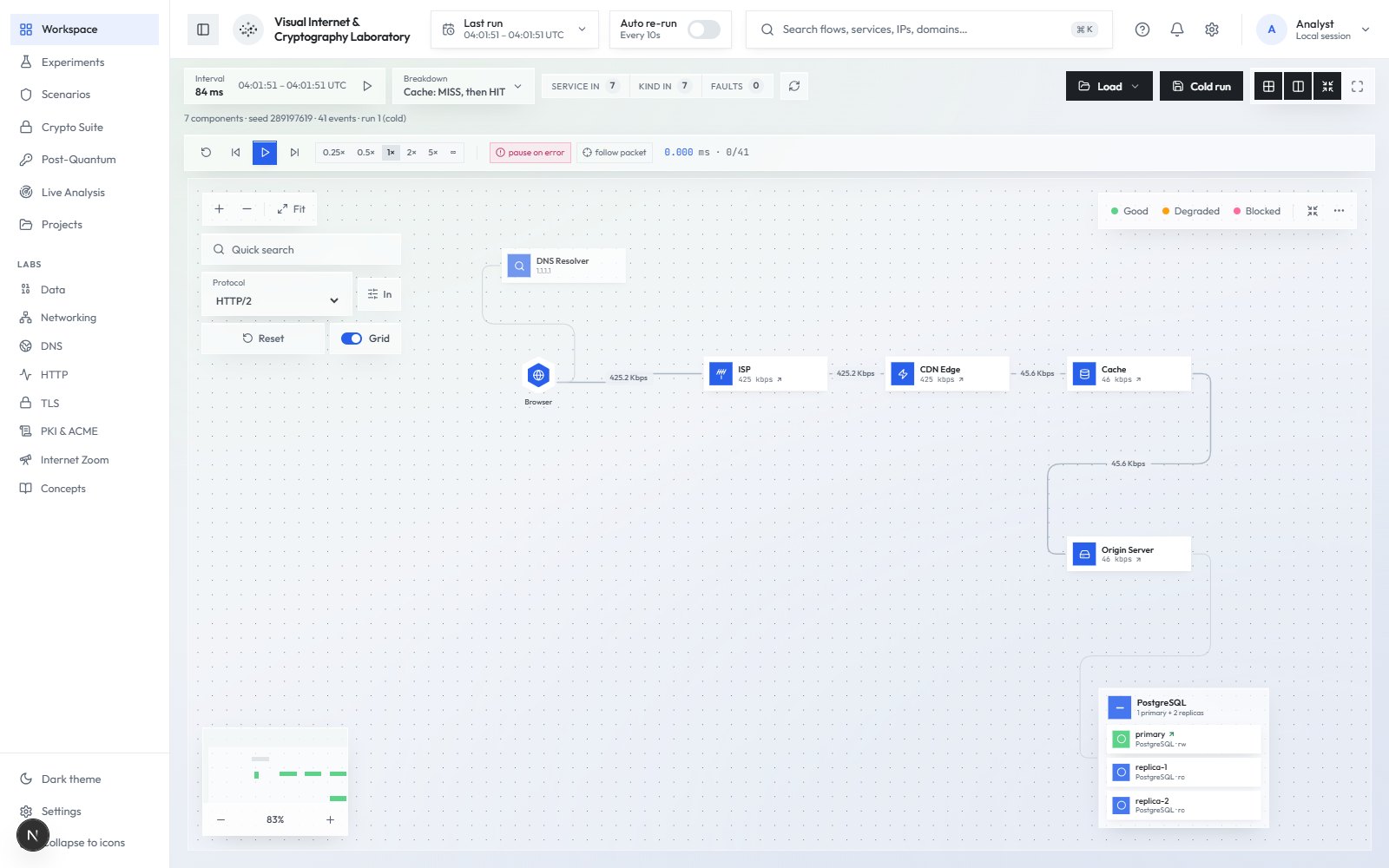
Full-screen topology map

Year
2026
Type
Web Platform + Rust Service
Role
Solo Developer
Highlights
Built a deterministic protocol engine: same architecture, seed and carried state always produce a byte-identical event stream, which makes stepping backwards, scrubbing and run comparison exact.
Implemented MD4, SHA-256, AES, DES and RSA from scratch with full internal tracing, verified against FIPS-197 and other official vectors.
Shipped 34 preset architectures, 48 component kinds, 27 sandboxed Break-It failure modes and a 143-entry concept knowledge base.
323 tests passing, typecheck and production build green, and the Rust probe clean under clippy with warnings denied.
Engine
No React, pure event stream
Modes
Simulation + Live analysis
Technical Implementation
Engine and UI separation: All protocol logic lives in an engine layer that never imports React. The UI has no hand-authored animation sequences; it animates whatever the engine emits. Randomness goes through a seeded PRNG, and state that only matters between requests (edge cache, connection pool, TLS tickets, ARP table, BGP state) is carried in an explicit run context, so a cache MISS followed by a HIT is observable without breaking determinism.
Protocol depth: HTTP/1.1, HTTP/2 and HTTP/3 produce genuinely different stacks. HTTP/2 encodes real HPACK bytes with dynamic-table eviction; HTTP/3 runs over QUIC with QPACK and emits no TCP events at all. BGP announcements propagate through real RIBs with policy and RPKI, a Kubernetes Service picks an endpoint from a real EndpointSlice, and a request cannot leave the host until ARP has resolved the gateway.
Real cryptography: The complete TLS 1.3 key schedule (RFC 8446 §7.1), QUIC Initial protection keys checked against RFC 9001's own vectors, X25519MLKEM768 hybrid key exchange, ML-KEM, ML-DSA and SLH-DSA, and measured PBKDF2, scrypt and Argon2id in a worker. Ethernet, IPv4, TCP, UDP, ICMP and TLS record headers are built byte by byte with real checksums.
Live analysis: A server route measures real hosts (DNS records, TLS version, cipher, ALPN, certificate chain, response headers) and labels every value as observed, inferred, simulated or unknown. Live observations are converted into ordinary engine events so the same timeline and inspector render them, and the clock only advances by what was actually measured.
Rust raw-socket probe: A zero-dependency Rust service that builds DNS queries and TLS ClientHellos by hand, writes them to the socket and parses the replies field by field, so the group a server actually selected is observed rather than inferred from a library's conclusions.
Focus
Honest output
Safety
SSRF guards on live requests
Design Decisions & Challenges
The main rule was never to fabricate. Where something is not executed, such as XTS mode, the app says so instead of producing fake ciphertext. Live runs report byte counts as unknown when that vantage point cannot see them, and a server's own reason phrase is shown rather than a made-up "OK".
Real requests are guarded on where they can go: private, loopback, link-local and cloud metadata addresses are refused, redirects are not followed automatically, request and response sizes are capped, and CR/LF in headers is rejected as injection. The UI names the target host and method before anything is sent.
Writing tests surfaced real bugs: a bare hostname silently falling back to a default domain, a hostname validator in the probe that accepted a lone hyphen, and a node selection loop that cleared the canvas. Performance budgets were also flaky under parallel test workers, so the benchmarks moved to their own serial pass and use the best of several runs.
The limits are documented rather than hidden: packet payloads are described rather than sealed byte for byte, BGP omits MRAI timers, and Kubernetes is modelled behaviourally rather than as an iptables or eBPF datapath.